
How to choose the best passive house builder in Sydney.
There is no single “best” builder. There is the right builder for your block, your brief, and your budget. This is the framework we would use ourselves to compare any passive house builder in Sydney, including us.
Start here
“Best” is not a ranking. It is a fit.
Most lists of “best passive house builders” are written by whoever wants to rank first. That is not useful when you are about to spend seven figures on a home your family will live in for decades.
A more honest approach is to give you the criteria that genuinely separate one passive house builder from another, then let you score everyone on your shortlist, us included. If we are the right fit, it will be obvious. If we are not, this page should save us both time.
The five criteria
What actually separates a passive house builder.
Five things decide whether a home performs the way it was promised. For each one: what to look for, the question to ask, and the red flag to watch for.
Certified, or just 'passive principles'?
Independent PHI certification, PHPP energy modelling, and a blower-door airtightness test on completed homes.
“Can you show me a blower-door result and the PHPP model from a home you have finished?”
Brochure language like 'passive principles' or 'eco-inspired' with no measured numbers behind it.
One team, or a handoff?
Design and construction held under one contract, so nobody can blame the other when something goes wrong.
“Who is accountable if the design and the build disagree, and is it the same entity?”
An architect who 'finds a builder later', or a builder who never read the original brief.
Fixed price, or allowances?
A line-item fixed-price contract issued after pre-construction, with no placeholder allowances waiting to expand.
“Is the contract fixed-price, and how many allowances are still open at signing?”
A low headline number propped up by 'provisional sums' that quietly grow during the build.
Will the principal be on your build?
A deliberately limited number of projects per year, so the people you meet are the people who deliver.
“How many homes do you contract each year, and who is on site at the critical stages?”
High volume with a sales team out front and a rotating cast of site supervisors behind it.
Can they prove the outcome?
Real completed projects, measured performance, and owners who will talk about living in the home.
“Can I see a finished home and speak to the family who lives in it?”
Renders and awards, but no measured results and no owners to talk to.
The landscape
Four kinds of builder you will meet.
Sydney’s passive house market has a few distinct models. None is automatically wrong. Each carries a different risk you should understand before you sign.
Volume builder, passive add-on
A high-output builder offering a 'passive' upgrade on a standard product. Process is efficient, but the envelope detailing and airtightness rigour a certified home needs are hard to deliver at volume.
Architect-led, external builder
Strong design, but construction is tendered out. Accountability for performance is split between the architect and whoever wins the build, and the brief can get lost in the gap.
Sole operator
Often genuinely skilled, but with limited process and documentation. Certainty on cost, programme, and certification can be thin when one person carries everything.
Integrated certified builder
Design and construction under one roof, built to certified Passive House standard, with the principals across every project. This is where Marvel Homes sits, by deliberate design.
The scorecard
Seven questions to ask any builder.
Take these to every builder on your shortlist. A confident, certified builder will answer all seven without hesitation. Print it, or bring it to your first meeting.
Are your completed homes certified to the Passive House Institute (PHI) standard?
Can you show a blower-door airtightness result from a finished project?
Are design and construction held under one contract and one accountable team?
Is the contract fixed-price after pre-construction, with allowances disclosed?
How many homes do you contract each year, and who is on site at key stages?
Can I visit a finished home and speak to the owners?
Will you tell me honestly if my site or brief is not the right fit?
Score us too
How Marvel Homes measures up.
Run us through the same five criteria. Here is where we stand, with the proof points behind each.
Two engineers run every project. Mo Amin (Civil Engineer, Licensed Builder NSW #330031C) and Ibrahim Amin (Mechanical Engineer, Licensed Builder, Certified Passive House Tradesperson) read the structural, geotechnical, and energy reports themselves.
Every Marvel home is built to PHI certification standard, independently certified to the Passive House standard by a third-party PHI-accredited certifier, and blower-door tested at handover.
Design and construction sit under one roof. After pre-construction we issue a line-item fixed-price contract. Any unavoidable allowance is named and priced realistically, never hidden.
We build five to eight homes a year by choice, not capacity. A tight team does the work and the directors stay across your build from the first conversation to the keys, not one of fifty jobs.
Common
questions
Comparing passive house builders in Sydney.
How do I compare passive house builders in Sydney?
+
Compare on five things, not on price alone: whether they build to certified Passive House (PHI) standard or just 'passive principles', whether design and construction sit under one contract, whether the price is fixed after pre-construction or carries allowances, how many projects they take on each year, and whether they can show measured performance from completed homes. Apply the same questions to every builder on your shortlist and the differences become clear.
What is the difference between a certified passive house and one built to 'passive principles'?
+
A certified passive house is independently modelled in PHPP and blower-door tested against the Passive House Institute (PHI) standard, so the performance is measured, not claimed. 'Passive principles' has no independent verification and no measured outcome. Marvel Homes builds to PHI certification standard, independently certified to the Passive House standard by a third-party PHI-accredited certifier, with Ibrahim Amin, a Certified Passive House Tradesperson, leading construction.
Should I choose an architect first or a builder first?
+
Both models can work, but they carry different risks. An architect-led project where the builder is found later can leave design and construction accountability split, which is where briefs get lost and costs drift. An integrated builder-first model, like Marvel Homes, holds design and construction under one team and one contract, so the brief, the budget, and the build stay aligned from the first conversation to handover.
Why does the number of projects a builder takes on matter?
+
Marvel Homes takes five to eight homes a year by choice, not capacity. A tight team does the work while Mo Amin (Civil Engineer, Licensed Builder NSW #330031C) and Ibrahim Amin (Mechanical Engineer, Licensed Builder, Certified Passive House Tradesperson) stay across every build from brief to handover, rather than supervising dozens of jobs at once.
What is the lowest-risk way to start with a passive house builder?
+
Start with a structured site assessment before you commit to a full build. It gives you a clear read on what your block allows, the likely cost drivers, and whether a builder is the right fit, with no obligation to proceed. It is the lowest-risk first step and the report is useful regardless of who you ultimately build with.
Compare us against your whole shortlist.
Start with a conversation about your block and brief. We will tell you honestly whether a Marvel build is the right fit, and the answers you take away are useful no matter who you build with.
See how we build→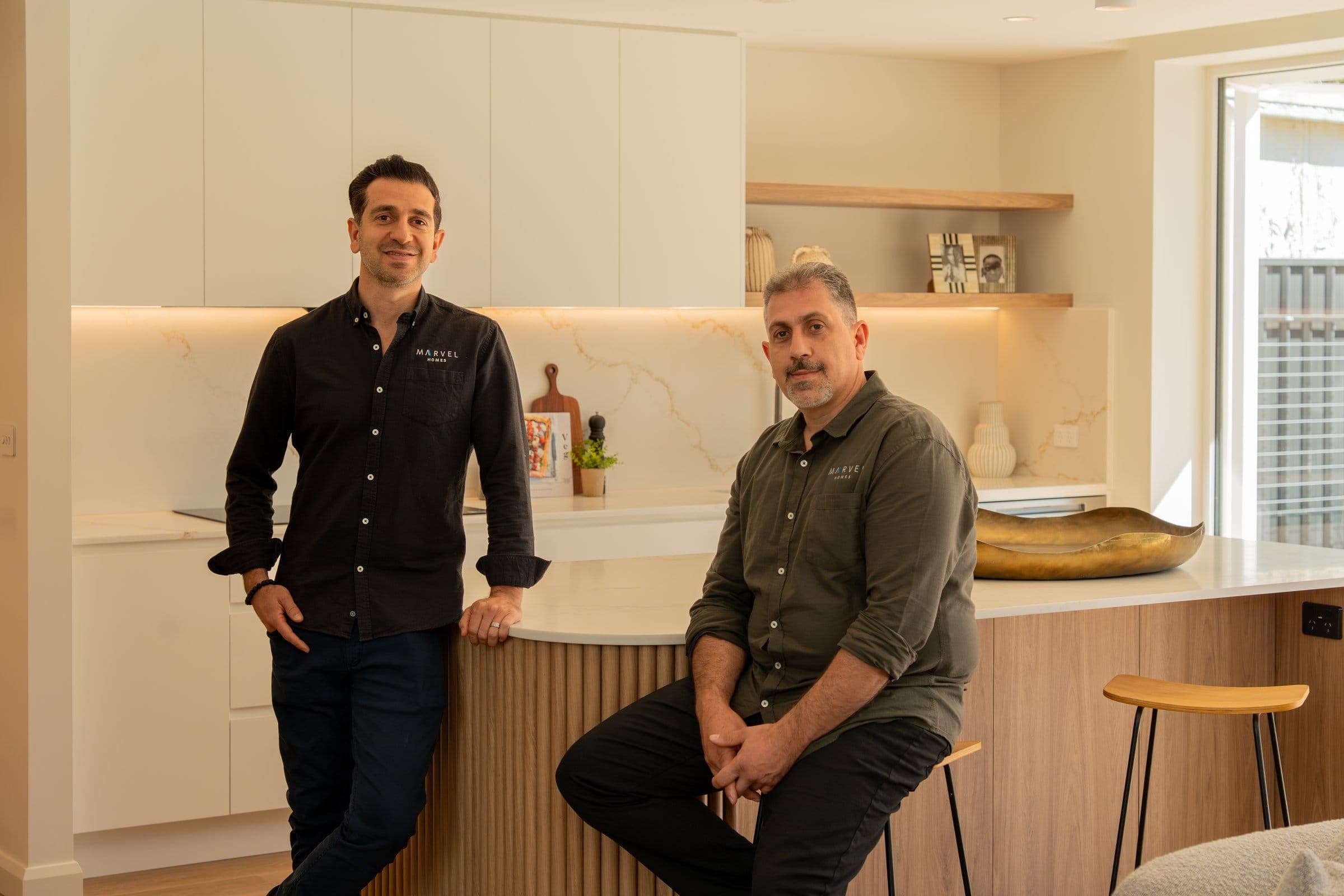
Mo Amin + Ibrahim Amin
Engineers · Licensed Builders · Certified Passive House Tradesperson