
Architect, builder, or design and construct. The decision that shapes everything.
Almost every custom home client faces this question before a single drawing is made. Who goes first? The answer is not just procedural. It determines who owns your plans, who is on your side during construction, how much you can compare prices, and whether your home ever performs the way you imagined.
What you are really choosing
Most people focus on design. The real choice is about control.
When people ask “architect or builder first?” they usually mean: who do I call? The answer they get is rarely complete, because the question underneath is bigger.
The pathway you choose determines four things most clients only think about after a problem surfaces:
Who owns your plans
And whether you can take them with you if you change your mind.
Who is on your side during construction
The architect, the builder, or just you.
When you learn the real cost
At design, at tender, or after the slab.
Whether your home can perform
Passive house and high-performance outcomes are designed in or they are not designed at all.
The four pathways
Four ways to build a custom home. Each one leaves something different on the table.
None of these pathways is wrong. Each one involves real trade-offs. The right one depends on how you weight design control, cost certainty, plan ownership, and construction performance against each other.
Architect first, builders at tender
The traditional model. You hire a registered architect independently, they design and get the home approved, then you go to the market for build prices.
What you gain
- You own the plans outright. Any builder, any time, forever.
- Your architect is contractually on your side, not the builder's.
- You can get multiple build prices and compare apples to apples.
- Contract administration by your architect during the build adds a professional layer of protection.
What to know
- Architects give cost opinions, not cost certainty. The first build price can arrive well above your budget.
- If the design comes in over budget, redesigning costs more fees and more time.
- Most architects are not passive house or high-performance specialists. Performance detailing can be missed entirely at the design stage.
- You are managing two separate professional relationships. Disputes become triangular.
Clients who prioritise design quality and independent protection, and can absorb the uncertainty between design fees and the eventual build price.
Independent building designer or draftsperson
A step below a registered architect in professional standing, but lower fees and the same core outcome: you own the plans and can tender them to any builder.
What you gain
- Lower design fees than a registered architect.
- You own the plans. Change builders at any point without losing documentation.
- Multiple builders can price the same set of drawings. Genuine price comparison.
What to know
- Building designers cannot administer a construction contract. You have no independent professional watching the build on your behalf.
- Design quality is typically more conservative and less bespoke than an architect's work.
- Without a builder's cost input during design, budget blowouts at tender are common.
- Performance detailing (airtightness, passive house, HRV) is almost never part of a building designer's scope.
Clients on tighter design budgets who want plan ownership and price comparison flexibility but can self-manage the construction process.
Design and construct: the builder's designer
One agreement covers both the design and the build. The builder engages a designer on your behalf. One point of accountability, but read the fine print on plan ownership.
What you gain
- One contract, one point of accountability. No finger-pointing between designer and builder.
- Cost knowledge is in the room during design. Budget surprises at tender are less likely.
- Typically faster from engagement to construction start.
What to know
- You may not meet the designer before you sign. If the creative relationship does not work, your options are limited.
- Plan ownership is frequently retained by the builder under a design-and-construct agreement. If you leave mid-design, you may walk away with documentation you cannot legally use.
- The designer's loyalty sits with the builder, not with you. Design decisions are filtered through what suits the builder to build.
- Performance outcomes depend entirely on the builder's capability. Most design-and-construct firms are not passive house builders.
Clients who prioritise process simplicity and cost certainty, and who trust the builder's design range before they have seen the designer's work.
Collaborative build: design and construction together from day one
A builder with genuine design capability (or one who works alongside your chosen architect from the first sketch) puts cost, buildability, and performance in the room before a single wall is designed.
What you gain
- Real cost feedback during design, not at tender. Fewer redesigns, less wasted time.
- Performance engineering built in from the start. Passive house detailing is designed, not bolted on.
- If you bring your own architect, they keep the design relationship. The builder adds cost and performance expertise.
- Single team from sketch to handover. No adversarial gap between what was designed and what gets built.
- Fixed price once the design is resolved, not a tender guess.
What to know
- This model requires finding a builder who genuinely has design capability and performance expertise. Many who claim it are volume builders with a fixed catalogue.
- The collaboration only works if the builder is brought in at concept. A builder added after design is complete can rarely fix what was not detailed in.
Clients building a custom home who want design quality, certified performance, and cost control without managing three separate professional relationships under pressure.

If you had to leave your builder tomorrow, what would you walk away with?
Plan ownership
The question nobody asks until it is too late.
If the relationship with your builder breaks down at any point before construction completes, what documentation do you leave with? This is the most important question in any building engagement, and it is rarely asked before signing.
The answer changes completely depending on which pathway you chose.
You own the plans. Always. Change builders at any stage and take your approved documentation with you. The architect's fees are sunk, but the output is yours.
Same structure as an architect engagement. The plans are yours. You can tender to a new builder, pause the project, or hold them on file indefinitely.
Read the agreement carefully. In many design-and-construct contracts, the builder retains intellectual property in the design until construction is complete, sometimes permanently. You may leave mid-process with documentation you cannot legally use elsewhere. This is not universal but it is common. Ask before you sign.
This varies by agreement. At Marvel Homes, your design is yours. But this is something to confirm in any collaborative engagement before work begins. A builder who is reluctant to clarify this early is a signal worth noting.
The rule of thumb:if you engaged the designer independently, the plans are yours. If the builder engaged the designer, the plans may be the builder's. This is a negotiating lever, a security blanket, and a measure of who this project really belongs to.
Side by side
The four pathways compared.
| 01Architect first, builders at tender | 02Independent building designer or draftsperson | 03Design and construct: the builder's designer | 04Collaborative build: design and construction together from day one | |
|---|---|---|---|---|
| Plan ownership | Yours, always | Yours, always | Often retained by builder | Yours (confirm in agreement) |
| Design control | High. Brief-led by an independent professional. | Moderate. Building designer follows your brief. | Moderate. Filtered through builder's preferred methods. | High. Your brief, with real cost and performance input. |
| Independent protection during construction | Yes. Architect administers the contract. | No. You manage the builder directly. | No. Builder is both designer and constructor. | Varies. Can structure with separate CA if needed. |
| Cost certainty | Low until tender | Low until tender | High once contract signed | High. Cost tracked through design. |
| High-performance / passive house capable | Only if architect has specialist knowledge | Rarely | Rarely | Yes, by design |
| If you change your mind mid-process | Take your plans and leave | Take your plans and leave | Check the agreement carefully | Discuss early. At Marvel, your design is yours. |
Yours, always
Yours, always
Often retained by builder
Yours (confirm in agreement)
High. Brief-led by an independent professional.
Moderate. Building designer follows your brief.
Moderate. Filtered through builder's preferred methods.
High. Your brief, with real cost and performance input.
Yes. Architect administers the contract.
No. You manage the builder directly.
No. Builder is both designer and constructor.
Varies. Can structure with separate CA if needed.
Low until tender
Low until tender
High once contract signed
High. Cost tracked through design.
Only if architect has specialist knowledge
Rarely
Rarely
Yes, by design
Take your plans and leave
Take your plans and leave
Check the agreement carefully
Discuss early. At Marvel, your design is yours.
The gap no pathway solves by itself
None of these pathways guarantees your home will perform.
A beautifully designed architect-led home can still be cold in winter and unbearable in summer if the builder does not understand how to build airtight. A fast design-and-construct build can come in with a nice facade and a thermal envelope that leaks twenty times more air than a certified passive house.
Performance is a construction question, not just a design question. And the most expensive detail to fix is the one that is already inside the wall.
Certified passive house target. Airtightness measured by a blower-door test.
Typical new Australian home. More than twenty times leakier. Source: CSIRO.
Less energy than a standard home. In a certified passive house.
The only way to deliver this standard is to have the performance engineering in the room at concept. Whichever pathway you choose, ask your team early: how is the airtightness layer being designed? Who is modelling the thermal performance? Who blower-door tests the build?
If the answer is unclear, the performance is unclear.
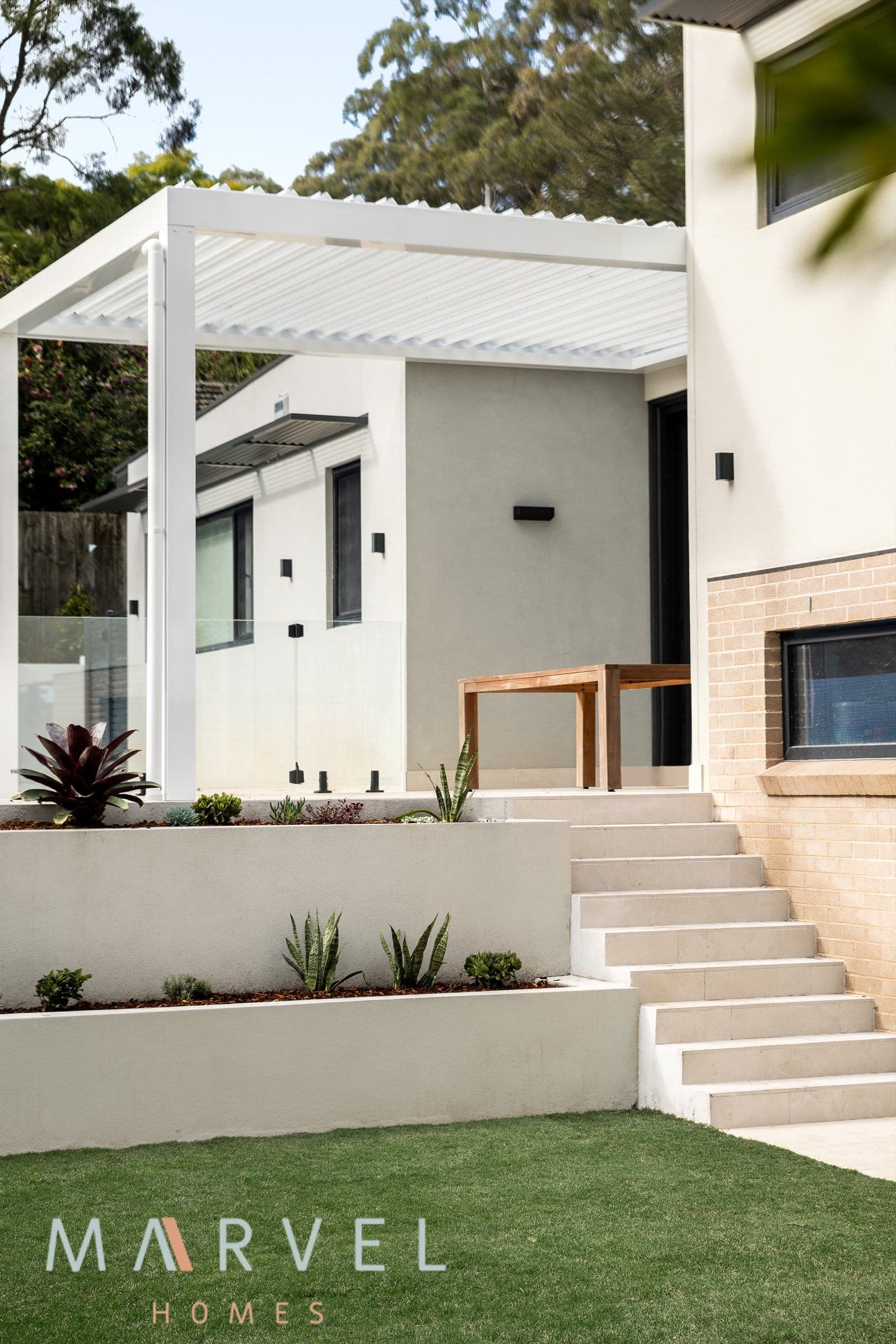
Architect-led design. Marvel built and certified. The design survived the build because both teams were in the room from concept.
Where we sit
We hold both sides of the table. Design and construction, one team.
Marvel Homes designs and builds. When clients arrive with an architect they love, we work alongside that architect from the first sketch, adding cost knowledge and certified passive house performance detailing without taking over the design relationship. When clients arrive without a designer, we design the home ourselves.
In both cases: the construction cost is tracked through design, not discovered at tender. The passive house performance is engineered in from the first sketch, not added at the end. And the fixed-price contract is built on a fully specified design, not a stack of allowances.
We do not hand your project to a subcontracted designer you have never met. We do not retain plan ownership as a negotiating tool. What you build your brief on is yours.
If you have an architect
We work alongside them. They keep the design. We add cost, buildability, and certified performance.
If you do not have an architect
We design the home ourselves. Engineers on both the civil and mechanical sides. Passive house modelled in PHPP.
Passive house certification
Independently certified by a third-party PHI-accredited certifier. Blower-door tested at handover, not just claimed on paper.
Fixed price
Not given until the design is resolved. Every specified element is drawn and documented. No guessing dressed up as an allowance.
What it actually costs
The real cost of getting the sequence wrong.
We have seen people spend a year and tens of thousands in fees getting a design approved, then watch the first build price come back close to double the budget they started with. The design is loved, the money is spent, and every choice from that point is a hard one.
This is not the architect's fault. The Australian Government's Your Home guide is direct about it: a designer gives an opinion of probable cost, not a guaranteed build price. Their own advice is to bring a builder in during design development to check the design can be built within budget. That is exactly what a collaborative engagement does.
A change on a drawing costs a fraction of the same change made during construction. The earlier the builder is in the room, the cheaper it is to resolve cost, performance, and buildability. This is not a sales point. It is the structure of how buildings work.
Common
questions
Architect or builder first, answered.
Should I hire an architect or builder first when building a custom home in Sydney?
+
It depends on your priorities. If design quality and plan ownership matter most, hire an architect first independently. If cost certainty and a streamlined process matter most, a design-and-construct builder may suit you. The most effective approach for a high-performance custom home is to engage a builder with genuine design capability at the concept stage, so cost, buildability, and performance are all in the room from day one.
Who owns the plans if I go with a design-and-construct builder?
+
This varies by agreement and must be checked before signing. In many design-and-construct contracts, the builder retains intellectual property in the design until construction is complete, or in some cases permanently. If you leave mid-process, you may have limited rights to take your documentation elsewhere. With an independently engaged architect or building designer, the plans are yours and you can change builders at any point.
What is the risk of hiring an architect without involving the builder early?
+
The main risk is a design you love that the market prices far above your budget. An architect gives an opinion of probable cost, not a guaranteed build price. The Australian Government's Your Home guide advises bringing a builder in during design development to validate that the design can be built within budget. Without that check, you may spend a year and tens of thousands in fees before learning the real cost.
Can a design-and-construct builder deliver a certified passive house?
+
Only if the builder has genuine passive house expertise and integrates it from the concept stage. Passive house airtightness, thermal bridging elimination, and mechanical ventilation must be designed in from the first sketch. A standard design-and-construct firm does not have this capability. Marvel Homes is a certified passive house builder led by two engineers with a Certified Passive House Tradesperson on staff.
What does a building designer do differently from a registered architect?
+
A registered architect holds a government-issued licence, carries professional indemnity insurance, and can legally administer a construction contract on your behalf (the contract administration or CA role). A building designer or draftsperson can prepare DA-level drawings but typically cannot administer the contract or provide the same level of professional accountability. For a bespoke custom home, the architect's CA role is a meaningful protection during construction.
What happens if I do not like the builder's in-house designer?
+
This is a real risk. When you engage a builder first and accept their design team, you may not meet the designer until the engagement begins. If the design relationship does not work, your options are to push through, accept an outcome you are not happy with, or leave. Leaving mid-design with a builder's designer often means walking away with incomplete documentation you may not legally own. Vetting designers before signing is important in any pathway.
Bring your architect, your brief, or just your questions.
Whether you have a designer already or are starting from scratch, the earlier we talk, the easier the build. We will walk you through what a collaborative engagement looks like, what it costs, and what you walk away with at every stage.
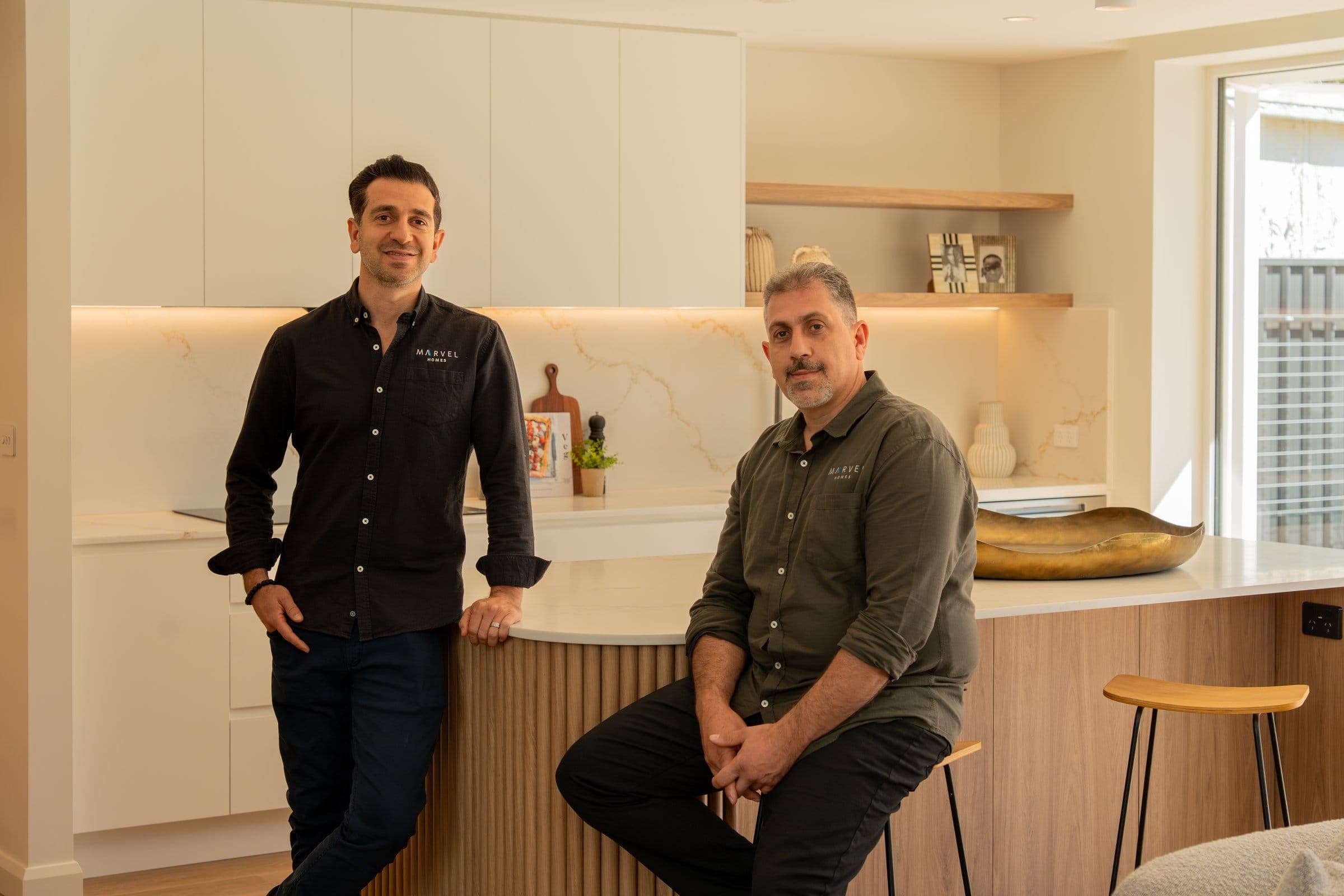
Mo Amin + Ibrahim Amin
Engineers · Licensed Builders · Certified Passive House Tradesperson